
COR, TIGS, and rail contractor prequalification: what to verify
A procurement guide to the safety certifications, training designations, and public records worth checking before awarding railway construction or maintenance work in Western Canada.
- Published
- Updated
- Reading time
- 4 min
The short answer
Check the legal company name, current safety certification, relevant personnel qualifications, insurance, equipment suitability, and comparable work. COR recognition and training records answer different questions; verify both against the owner's procurement and track-access requirements.
Awarding railway work is different from awarding most construction. The site is an operating railway, the work is governed by federal or provincial track safety rules, and the consequences of a poorly qualified crew include derailments, injuries, and long closures. Procurement teams that are used to general construction often ask what, specifically, they should verify before shortlisting a rail contractor.
This article walks through the certifications, designations, and public records that are worth checking, what each one actually tells you, and where to find them.
Safety certification: COR
A Certificate of Recognition, or COR, confirms that an employer's health and safety management system has been audited against a provincial standard and found to meet it. In Alberta, COR is issued through certifying partners such as the Alberta Construction Safety Association, and the Government of Alberta publishes a searchable list of current COR holders. British Columbia and Saskatchewan run comparable programs through their own safety associations.
What COR tells you:
- The contractor has a documented health and safety program, not just a policy statement.
- That program has been audited by a third party, and the certificate has an expiry date.
- The contractor participates in the provincial system that ties safety performance to workers' compensation rates.
What COR does not tell you:
- Anything specific about railway work. COR is a general occupational health and safety credential.
- Actual field performance. Ask for incident statistics separately.
Where to verify: the Government of Alberta's public COR registry, or the equivalent listing in the relevant province. A contractor should be able to give you their certificate number and expiry date on request.
Track inspection qualification: TIGS
Transport Canada's Rules Respecting Track Safety apply to federally regulated standard-gauge track and address track inspector and supervisor qualifications. Other jurisdictions and track owners may have additional requirements. Ironhorse describes its inspection personnel as TIGS-trained; ask for the relevant training records, current qualifications, and the owner's acceptance requirements rather than treating a training label as universal authorization to inspect every railway.
For a procurement team, TIGS-trained personnel matter in two situations:
- Inspection contracts. If you are hiring a contractor to inspect your track, the inspectors need to be qualified to the standard the track is regulated under.
- Construction and maintenance. Finished track has to be inspected before it returns to service. A contractor with qualified inspectors on staff can complete that step without waiting for a third party.
Ask who on the contractor's team holds the qualification, when they were trained, and whether they have inspected the class of track you own.
Railway-specific qualifications
Every railway in Canada operates under a rulebook. Contractors working on or near a railway's track need personnel qualified under that railway's rules, which typically means:
- Canadian Rail Operating Rules (CROR) qualification for anyone providing track protection or foul-time protection.
- Railway-specific safety orientations for the Class 1, shortline, or industrial railway involved.
- Contractor safety programs such as e-RAILSAFE or equivalent, which many railways require for contractor access.
A contractor that regularly works on a given railway will have current qualifications for it. If your track connects to a railway, the contractor's ability to work at the connection point depends on these.
Equipment and operator qualification
Track machines are specialized and, in the wrong hands, dangerous. Verify:
- Operators are trained on the specific machines being proposed.
- Hi-rail equipment has current inspections.
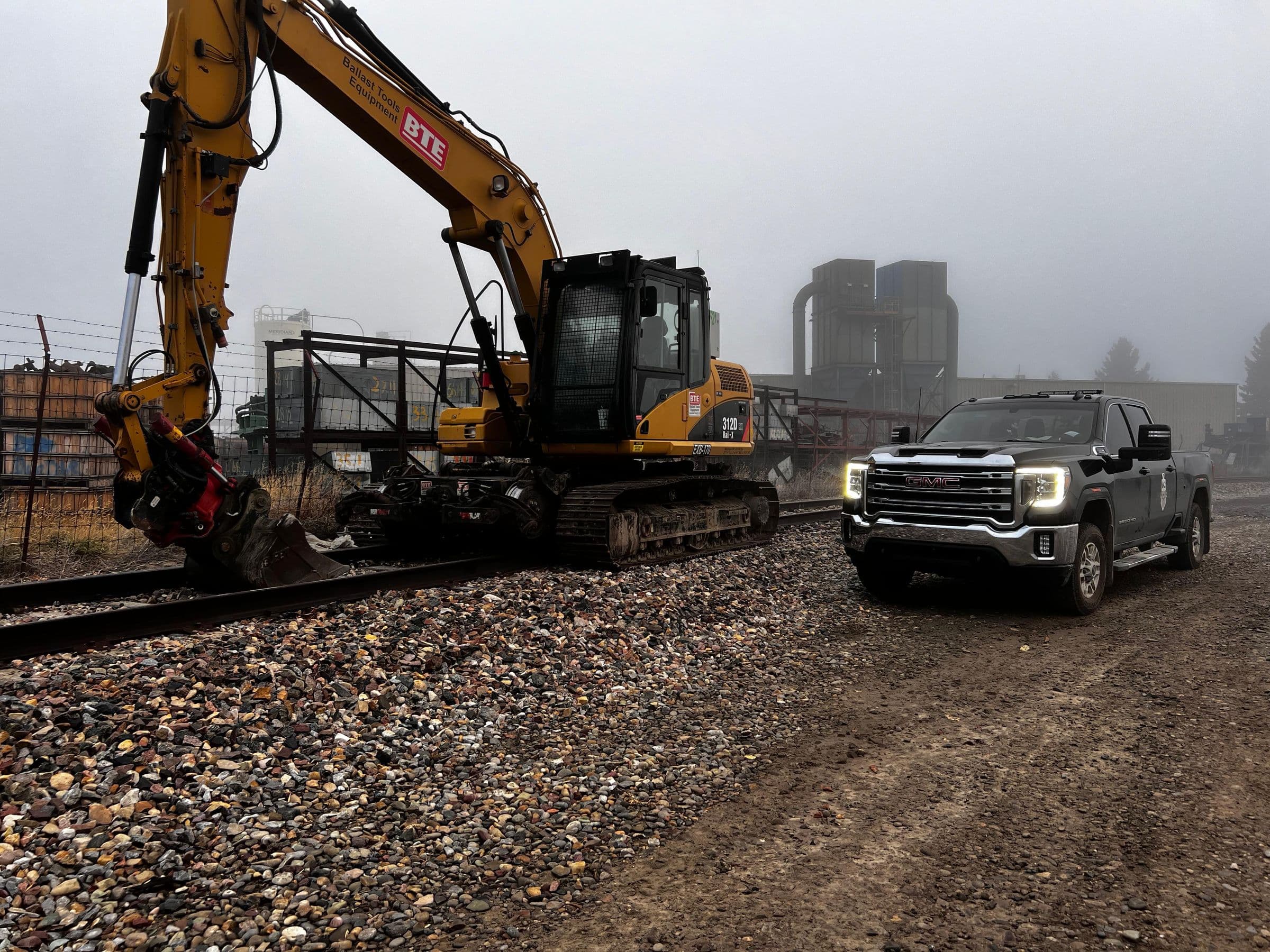
- Heavy transport is licensed and insured for the loads involved, with Class 1 drivers for the tractor-trailer combinations.
Public records worth pulling
Independent evidence is more useful than a reference list the contractor selects. Several public sources will name contractors on railway work:
- Government major project registries. Provincial governments publish registries of significant capital projects, often naming the contractors.
- Municipal tender results. Cities and towns that own rail assets publish tender awards and results, including bidder lists and award values.
- Owner acknowledgements. Public bodies and Crown corporations sometimes publish completion notices naming contractors.
- Provincial safety registries. COR registries, as above.
A contractor who can point you to these records has given you something you can check without taking their word for it.
A prequalification checklist
| Item | What to ask for | How to verify |
|---|---|---|
| COR or equivalent | Certificate number and expiry | Provincial registry |
| Track inspection qualification | Names and training dates of qualified personnel | Training records |
| Railway rules qualification | CROR and railway-specific cards | Current cards |
| Contractor safety program | e-RAILSAFE or equivalent status | Program lookup |
| Insurance | Certificate with railway-specific coverage | Insurer confirmation |
| Equipment | Fleet list with inspection dates | Records |
| Public project record | Named projects with sources | Registry or tender links |
| Safety performance | Incident and lost-time statistics | Supporting records supplied by the contractor |
| Workers' compensation | Current clearance where required | Relevant provincial workers' compensation authority |
Where Ironhorse stands
Ironhorse Railroad Contractors Ltd. is listed by the Government of Alberta as a COR holder through the Alberta Construction Safety Association, employs TIGS-trained inspection personnel, and is named in public records including Alberta's Major Projects registry and City of Lethbridge tender results. The safety and compliance page collects the certifications, and the projects section links each documented project to its public source.
Sources and further reading
- Government of Alberta: find employers with a COR
- Transport Canada: Rules Respecting Track Safety
- City of Lethbridge: 2025 Railway Rehabilitation tender
Planning guidance for owners and procurement teams. Confirm site conditions, applicable jurisdiction, and the track owner's current requirements with qualified personnel before work begins.
Turn the plan into a project brief.
Gather the location, condition information, access windows, and scope before requesting a bid.
Common questions
What is a Certificate of Recognition (COR)?
COR is an occupational health and safety certification recognized by provincial governments and safety associations, confirming that an employer's health and safety management system has been audited against a provincial standard. In Alberta, holders are listed in a public government registry.
What does TIGS stand for in railway inspection?
TIGS refers to Transport Canada's Track Inspection Guidelines and the associated training that qualifies personnel to inspect track against the Rules Respecting Track Safety.