
What to have ready when you call for derailment response
The information a rail contractor needs in the first five minutes of a derailment call, and how it shortens the time to a cleared, inspected, reopened track.
- Published
- Updated
- Reading time
- 4 min

The short answer
Follow your emergency plan and contact emergency services where required. Give the response team the exact location, site contact, known hazards, affected equipment, track damage, and access constraints. Mobilization and reopening depend on the incident and the owner's acceptance requirements.
A derailment call rarely arrives with complete information. Someone on site has a phone, a rough location, and a problem that is getting more expensive every hour the track stays closed. The contractor on the other end of the line has to turn that call into a crew list, an equipment list, a transport plan, and a route to the site.
The faster the caller can answer a short set of questions, the faster the right package leaves the yard. This article lays out what those questions are, why each one matters, and how the answers change what gets loaded on the truck.
The first five minutes
Before anything moves, the dispatcher needs to know four things.
Where, exactly. A subdivision and mile point is ideal on railway-owned track. On industrial or private track, the nearest road crossing, the facility name, and a GPS pin from a phone are enough. The difference between a site that is reachable by paved road and one that needs a kilometre of hi-rail travel decides which machines can be used and how long it takes to get them on the rail.
What is on the ground. How many cars or locomotives are derailed, whether any are on their side, and whether any are loaded. A pair of empty hoppers with wheels off on a yard track is a re-railing job. A loaded tank car on its side is a different response involving the shipper, the railway, and emergency services before any track contractor touches it.
What the track looks like. Ties broken, rail rolled or kinked, a turnout involved, or a bridge or crossing within the damage area. This determines whether the crew brings re-railing gear only, or track panels, turnout components, ties, and a tamper for the rebuild.
Who else is involved. The serving railway, the facility owner, first responders, or a regulator. Response on a railway's track is coordinated through the railway. Response on a shipper's own spur is usually coordinated by the shipper, but the railway still has to approve the return of service to its connection.
Why dangerous goods change everything
If any derailed car carries dangerous goods, the response sequence changes. Placards, the shipping documents, and the consist from the railway or shipper tell responders what is in the car. Emergency services and the shipper's own emergency response plan take precedence, and the rail contractor waits for clearance before clearing equipment. Calling this out on the first phone call, even when the caller is not certain, avoids sending a crew into a site they cannot yet work on.
Access is the hidden variable
Rail contractors move heavy equipment by road and then put it on the rail at the nearest usable access point. Three questions shape the plan.
- Can a lowboy carrying a hi-rail excavator or a tamper reach the site, or is the last stretch too soft, too narrow, or gated?
- Is there a crossing or set-on location where equipment can go onto the track close to the damage?
- Is the track between the set-on point and the derailment intact enough to travel on?
The answers decide whether a machine is trucked to within sight of the problem or has to travel several kilometres on the rail, which can add hours.
What a response package usually contains
A typical package for an industrial or shortline derailment might include:
- A supervisor and crew qualified for the railway or the owner's rules
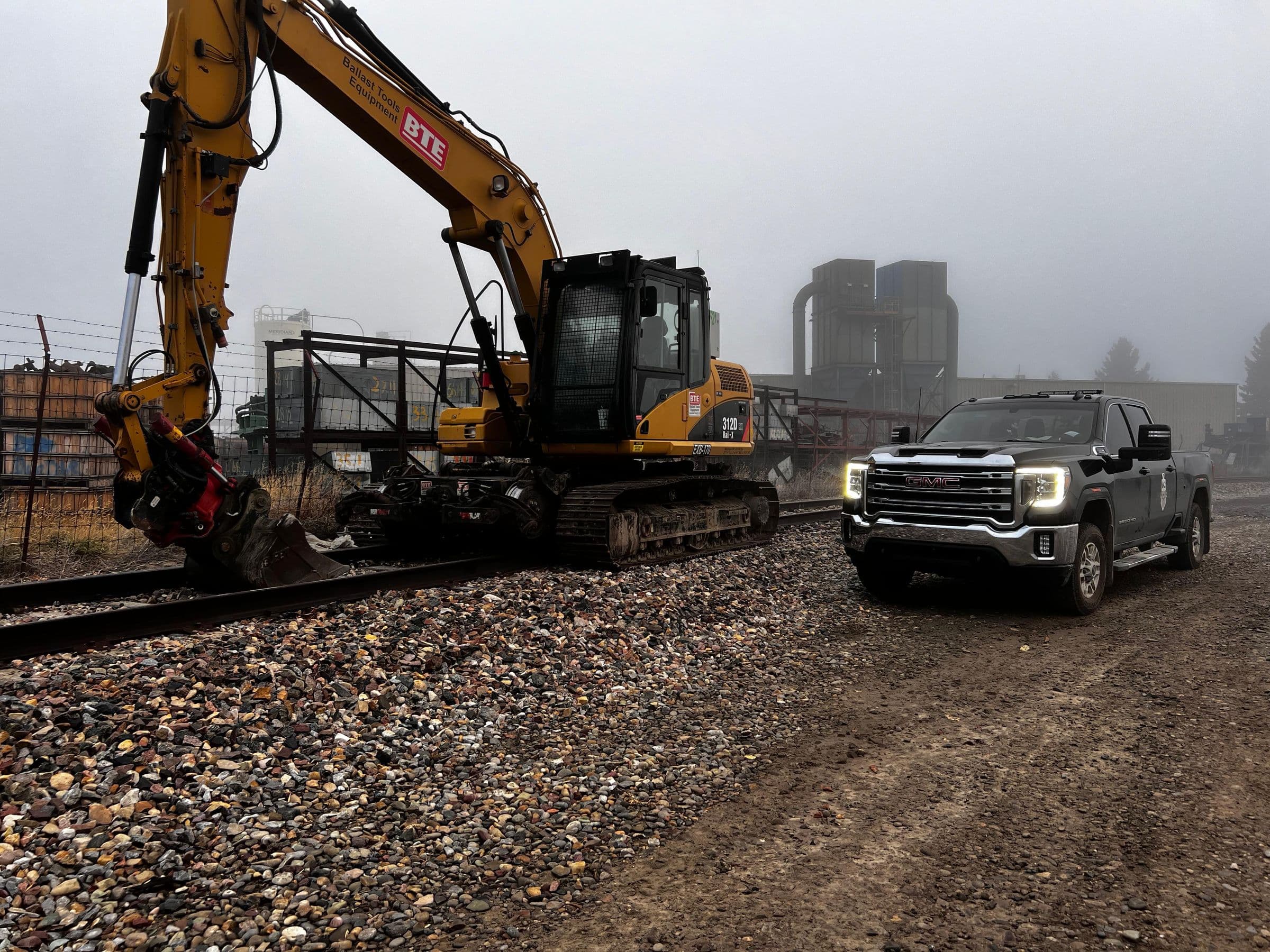
- One or more hi-rail excavators for lifting and re-railing
- Boom trucks for handling ties, rail, and panels
- Heavy transport for machines and materials
- Track materials sized to the reported damage: ties, rail, plates, spikes, anchors, and turnout components if a switch is involved
- A tamper and regulator if the rebuilt track needs surfacing before trains return
The contractor scales this up or down based on what the caller reported. Under-reporting damage sends an incomplete package and costs a second trip. Over-reporting is far less costly.
What happens after the site is cleared
Clearing the derailed equipment is only half the job. The track has to be rebuilt to the owner's standard, surfaced, and inspected before the first train. On railway-owned track, the railway's own inspector authorizes the return to service. On private track, the owner's inspector or a qualified contractor inspector does. Documentation of the rebuild, including what materials went in and what geometry was measured, becomes part of the owner's record.
A short checklist for the call
- Location: subdivision and mile point, or facility name, crossing, and GPS pin.
- Equipment: how many units, loaded or empty, upright or on their side.
- Dangerous goods: any placards, and whether emergency services are on site.
- Track damage: ties, rail, turnout, bridge, or crossing involved.
- Access: road condition for heavy trucks and the nearest set-on point.
- Contacts: who is in charge on site, and who at the railway or facility approves the plan.
Keeping this list near the dispatch phone at a rail-served facility is one of the cheapest ways to cut hours off a response.
Ironhorse lists derailment response among its railway services across Alberta, British Columbia, and Saskatchewan. Review the emergency response page and call 403-946-0169 to confirm crew availability and next steps.
Sources and further reading
Planning guidance for owners and procurement teams. Confirm site conditions, applicable jurisdiction, and the track owner's current requirements with qualified personnel before work begins.
Turn the plan into a project brief.
Gather the location, condition information, access windows, and scope before requesting a bid.
Common questions
Who should I call first after a derailment on private or industrial track?
Secure the site and follow your own emergency plan first. Then call the railway that serves you if the derailment affects their track, and a rail contractor that can mobilize crews, hi-rail equipment, and transport for clearing and repair.
How long does derailment response take?
Mobilization and recovery depend on the location, hazards, access, available crews and equipment, and damage. Track repairs, inspections, and the owner's authorization to resume operations also affect the timeline. Confirm the response plan directly; there is no universal reopening time.